Blog

  • GEO vs SEO: How AI-Powered Search is Changing Digital Marketing

    GEO vs SEO: How AI-Powered Search is Changing Digital Marketing

    Author: SHUBHAM Written on: 08/03/2026
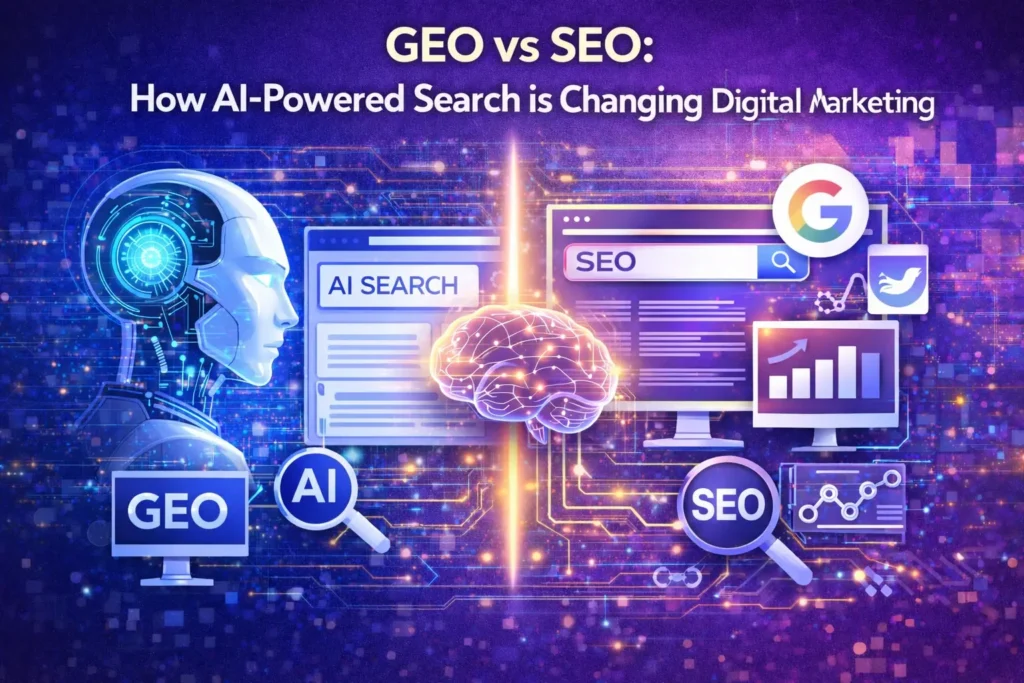
    GEO vs SEO comparison showing AI-powered search engines, generative engine optimization strategies, and traditional search engine optimization in digital marketing

    The digital marketing landscape is evolving rapidly. With the rise of artificial intelligence, search technology is transforming the way people discover information online. Consequently, marketers must rethink their strategies to remain visible in modern search environments.

    Traditionally, businesses relied on Search Engine Optimization (SEO), website ranking strategies, and search marketing techniques to improve their visibility on search engine results pages. However, AI-powered search engines such as Google’s Search Generative Experience, ChatGPT, and other intelligent assistants are introducing a new concept known as Generative Engine Optimization (GEO). Therefore, digital marketers must understand how GEO differs from traditional SEO and how both strategies work together in the future of search.

    In this article, we will explore the key differences between GEO and SEO, their role in digital marketing, and how businesses can adapt their strategies for AI-driven search.


    Understanding Traditional SEO

    Search Engine Optimization (SEO) focuses on improving a website’s visibility on search engines like Google and Bing.

    Typically, SEO involves strategies such as:

    • Keyword optimization

    • On-page SEO techniques

    • Technical website optimization

    • Backlink building

    • Content marketing

    As a result, websites can rank higher on search engine results pages and attract organic traffic.

    For beginners who want to understand the basics of search marketing, our guide SEO vs Google Ads: Which is Better for Beginners? explains how organic and paid strategies work together in digital marketing.


    What is Generative Engine Optimization (GEO)?

    Generative Engine Optimization (GEO) is a newer concept that focuses on optimizing content for AI-powered search engines and generative AI platforms.

    Unlike traditional SEO, where search engines display a list of websites, AI search engines generate direct answers and summaries based on information from multiple sources.

    Consequently, businesses must ensure their content is structured in a way that AI systems can easily understand and reference.


    Key Differences Between GEO and SEO

    Although GEO and SEO are closely related, they focus on different aspects of search visibility.

    Focus of Optimization

    SEO focuses on ranking higher in search engine results pages.

    On the other hand, GEO focuses on ensuring that AI systems can extract and reference content when generating answers.

    Search Results Format

    Traditional search engines show a list of links.

    However, AI search engines generate summarized responses that combine information from several sources.

    Content Structure

    SEO often focuses on keywords and backlinks.

    In contrast, GEO prioritizes structured content, clear explanations, and authoritative information that AI systems can interpret easily.


    Why GEO is Becoming Important for Digital Marketing

    AI technology is rapidly transforming the search ecosystem. As a result, businesses must adapt their strategies to stay competitive.

    Firstly, AI search engines are becoming more popular among users. Secondly, AI assistants provide instant answers instead of requiring users to browse multiple websites. Finally, generative AI systems rely on trustworthy sources when generating responses.

    Therefore, businesses that optimize their content using GEO strategies will have a greater chance of being referenced in AI-generated answers.

    If you want to understand how artificial intelligence is already transforming the marketing industry, you can read our article How AI is Changing Digital Marketing in 2026.


    How SEO and GEO Work Together

    Although GEO is a new concept, it does not replace traditional SEO.

    Instead, both strategies work together.

    For example:

    SEO helps websites appear in search engine results.
    Meanwhile, GEO ensures that AI systems can understand and summarize the content.

    Consequently, businesses should combine both approaches to maximize their digital visibility.


    Strategies for Optimizing Content for GEO

    To succeed in AI-driven search environments, digital marketers must adapt their content strategies.

    Create High-Quality Informative Content

    AI systems prefer content that is accurate, detailed, and well-structured.

    Therefore, marketers should focus on publishing educational guides, tutorials, and expert insights.


    Use Clear Content Structure

    Structured content helps AI systems interpret information.

    Best practices include:

    • Clear headings (H1, H2, H3)

    • Short paragraphs

    • Bullet points

    • FAQ sections

    As a result, generative search engines can easily extract key insights from the content.


    Focus on User Intent

    Understanding user intent is essential for both SEO and GEO.

    Instead of targeting only keywords, content should answer real user questions.

    For example:

    Users may ask
    “How does AI affect SEO strategies?”

    Therefore, content that clearly answers such questions is more likely to appear in AI-generated responses.


    Build Authority and Trust

    AI search engines prioritize credible and reliable sources.

    Businesses can build authority by:

    • Publishing expert content

    • Updating information regularly

    • Referencing trusted sources

    For instance, marketers who want to learn modern digital marketing strategies can explore educational resources provided by Vidya Sarthi Institute of Digital Marketing.


    The Future of Search: SEO + GEO

    The future of digital marketing will involve a combination of traditional SEO and Generative Engine Optimization.

    Some emerging trends include:

    • AI-generated search summaries

    • Conversational search queries

    • Voice search optimization

    • AI-driven personalized search results

    Consequently, marketers must stay updated with these developments to remain competitive.

    Businesses that understand both SEO and GEO strategies will have a significant advantage in the evolving digital landscape.

    Conclusion

    Artificial intelligence is reshaping the future of search. Consequently, digital marketers must adapt to the evolving landscape by combining traditional SEO techniques with Generative Engine Optimization strategies.

    While SEO helps websites rank in search engines, GEO ensures that AI systems can understand and reference the content. Ultimately, businesses that embrace both strategies will achieve greater visibility and long-term success in the AI-driven search ecosystem.

    Frequently Asked Questions (FAQ)

    What is the difference between GEO and SEO?

    SEO focuses on ranking websites in traditional search engine results pages, while GEO focuses on optimizing content so AI-powered search engines can generate answers using that content.

    Is GEO replacing SEO?

    No. GEO does not replace SEO. Instead, both strategies complement each other and should be used together.

    Why is GEO important for digital marketing?

    GEO is important because AI search engines are becoming more common and businesses need to optimize their content to appear in AI-generated search results.

    How can businesses prepare for AI search engines?

    Businesses should create high-quality content, structure information clearly, focus on user intent, and implement Generative Engine Optimization strategies.
  • How to Optimize Content for AI Search Engines: A GEO Strategy Guide

    How to Optimize Content for AI Search Engines: A GEO Strategy Guide

    Author: SHUBHAM Written on:08/march/2026
    Optimize content for AI search engines using Generative Engine Optimization (GEO) strategies and AI-powered SEO tools

    The digital search landscape is changing rapidly. As artificial intelligence continues to evolve, AI-powered search systems such as Google’s Search Generative Experience, ChatGPT, and other intelligent assistants are transforming how people discover information online. Consequently, digital marketers must adapt their strategies to remain visible in this new environment.

    Traditionally, businesses relied on Search Engine Optimization (SEO), website ranking strategies, and search marketing techniques to appear on search engine results pages. However, modern AI search engines now generate direct answers, summaries, and insights for users. Therefore, marketers must focus on Generative Engine Optimization (GEO), which ensures that content can be understood and referenced by AI-powered search systems.

    In this guide, we will explore how businesses can optimize their content for AI search engines and implement effective GEO strategies for the future of digital marketing.

    Understanding AI Search Engines

    Before optimizing content, it is important to understand how AI search engines work.

    Unlike traditional search engines, AI-powered systems analyze large volumes of information and generate responses based on context and intent. As a result, users often receive summarized answers rather than just a list of websites.

    These systems rely on technologies such as:

    • Natural Language Processing (NLP)

    • Machine Learning

    • Knowledge graphs

    • Contextual understanding

    Consequently, content must be structured clearly so that AI systems can easily extract relevant information.


    Why GEO is Important for Digital Marketing

    As AI search continues to grow, Generative Engine Optimization is becoming an essential digital marketing strategy.

    Firstly, GEO improves visibility in AI-generated answers. Secondly, it helps businesses become trusted sources of information. Finally, it ensures that content remains relevant in the evolving search ecosystem.

    For example, AI is already transforming many areas of marketing. If you want to explore how artificial intelligence is reshaping the industry, you can read our detailed article on How AI is Changing Digital Marketing in 2026.


    Create High-Quality and Informative Content

    High-quality content is the foundation of successful GEO strategies.

    AI search engines prioritize content that is:

    • Accurate

    • Informative

    • Well-structured

    • Helpful for users

    Therefore, marketers should focus on creating comprehensive guides, tutorials, and educational resources that answer user questions clearly.

    Additionally, longer and more detailed content increases the chances of being referenced by AI search systems.


    Structure Content Clearly for AI Understanding

    Structured content makes it easier for AI systems to interpret information.

    Best practices include:

    • Using clear headings (H1, H2, H3)

    • Writing short and readable paragraphs

    • Using bullet points where necessary

    • Adding FAQ sections

    Furthermore, structured content improves both readability and search visibility.


    Focus on Search Intent Instead of Just Keywords

    In the past, SEO focused heavily on keyword optimization. However, AI search engines now prioritize user intent and contextual understanding.

    Therefore, marketers should focus on answering real user questions.

    For example, instead of targeting only keywords like digital marketing strategies, you should address questions such as:

    • How can businesses improve online visibility?

    • What strategies help websites rank higher?

    • How can marketers adapt to AI search engines?

    As a result, your content becomes more useful and relevant.


    Use Internal and External Linking

    Internal and external links help AI systems understand relationships between content.

    For example, beginners who want to understand search marketing basics should explore the difference between paid advertising and organic optimization. Our article SEO vs Google Ads: Which is Better for Beginners? explains these strategies in detail.

    Similarly, external references improve credibility. For instance, professionals who want to learn modern digital marketing strategies can explore resources from Vidya Sarthi Institute of Digital Marketing, which provides insights into evolving marketing practices.


    Include FAQ Sections for AI Search

    FAQ sections play a major role in Generative Engine Optimization.

    AI systems often use FAQ content when generating answers for users.

    Therefore, adding a FAQ section:

    • improves clarity

    • increases the chances of appearing in AI search responses

    • enhances user experience

    As a result, many modern SEO strategies now include structured FAQ content.


    Optimize Content for Conversational Search

    Another important GEO strategy is optimizing for conversational queries.

    With the rise of voice assistants and AI chat systems, search queries are becoming more natural and conversational.

    For example:

    Instead of searching “SEO tips”, users may ask
    “how can I improve my website ranking?”

    Therefore, writing content in a natural, conversational tone improves visibility in AI search engines.


    The Future of GEO and AI Search

    Looking ahead, AI-powered search will continue to evolve.

    Some expected trends include:

    • AI-generated search summaries

    • Personalized search experiences

    • Voice and conversational search growth

    • Increased importance of authoritative content

    Consequently, digital marketers must continuously adapt their strategies.

    Businesses that combine traditional SEO techniques with Generative Engine Optimization strategies will be better positioned for long-term success.


    Conclusion

    AI search engines are transforming the way information is discovered online. Consequently, businesses must adapt their digital marketing strategies to remain competitive.

    By focusing on structured content, user intent, and authoritative information, marketers can ensure that their content remains visible in AI-generated search results. Ultimately, combining traditional SEO practices with Generative Engine Optimization strategies will help businesses succeed in the future of search.


    Frequently Asked Questions (FAQ)

    What is Generative Engine Optimization?

    Generative Engine Optimization (GEO) is the practice of optimizing digital content so that AI-powered search engines can understand and reference it in generated responses.

    How can businesses optimize content for AI search engines?

    Businesses can optimize content by creating high-quality articles, structuring information clearly, focusing on user intent, and including FAQ sections.

    Is GEO replacing traditional SEO?

    No. GEO complements traditional SEO. Businesses should combine both strategies to maximize visibility in modern search environments.

    Why are AI search engines important for digital marketing?

    AI search engines are important because they provide direct answers and summaries for users, making structured and authoritative content more valuable.

  • Generative Engine Optimization (GEO)

    What is Generative Engine Optimization (GEO)? The Future of SEO in the AI Era

    Author: SHUBHAM Written on: 08/03/2026
    Generative Engine Optimization (GEO) concept showing AI-powered search engines, SEO analytics, and digital marketing strategies in the AI era

    Search engines are evolving rapidly, and consequently the way people find information online is changing as well. With the rise of artificial intelligence, AI-powered search systems such as Google’s Search Generative Experience (SGE), ChatGPT, and other intelligent assistants are transforming the digital search landscape. As a result, a new concept known as Generative Engine Optimization (GEO) is becoming increasingly important in modern digital marketing.

    Traditionally, businesses relied on Search Engine Optimization (SEO), search marketing strategies, and website ranking techniques to appear higher on search engine results pages. However, AI-driven search engines now generate direct answers, summaries, and recommendations for users. Therefore, marketers must adapt their strategies to ensure that their content can be discovered, understood, and referenced by these generative AI systems.

    In this guide, we will explore what Generative Engine Optimization (GEO) is, how it differs from traditional SEO, and why it is becoming an essential strategy for digital marketers in the AI era.

    AI is already transforming many areas of digital marketing. If you want to understand the broader impact of artificial intelligence on marketing strategies, you can explore our detailed guide on How AI is Changing Digital Marketing in 2026.

    Understanding Generative Engine Optimization (GEO)

    Generative Engine Optimization (GEO) refers to the process of optimizing content so that it is discoverable and usable by AI-powered search engines and generative AI systems.

    Instead of only focusing on ranking in search results, GEO focuses on ensuring that AI systems can understand, summarize, and reference your content when generating answers for users.

    In other words, GEO ensures that your website becomes a trusted source for AI-generated search responses.

    Why GEO is Important in Modern Search

    AI search engines do not simply list websites. Instead, they analyze content across multiple sources and generate answers.

    This means that:

    • Users may get answers directly without clicking multiple links.

    • AI systems summarize information from trusted sources.

    • High-quality, structured content is more likely to be referenced.

    Therefore, businesses and marketers must optimize their content so AI systems can easily interpret it.

    Understanding the difference between traditional SEO strategies and modern search approaches is also important. For beginners, learning the basics of search marketing can start with understanding the difference between SEO and paid advertising. Our guide on SEO vs Google Ads: Which is Better for Beginners? explains how these strategies work together in digital marketing.


    How GEO Differs from Traditional SEO

    While SEO and GEO share some similarities, they focus on different aspects of search visibility.

    Traditional SEO

    Traditional SEO focuses on:

    • Ranking on Google search results

    • Optimizing keywords

    • Building backlinks

    • Improving website performance

    The goal is to appear higher on search engine results pages (SERPs).

    Generative Engine Optimization

    GEO focuses on:

    • Optimizing content for AI-generated answers

    • Structuring information clearly

    • Providing authoritative insights

    • Making content easy for AI systems to understand

    Instead of only ranking on search results, GEO helps your content become part of AI-generated responses.


    The Role of AI in Modern Search Engines

    Artificial intelligence is transforming how search engines understand and deliver information.

    Modern search systems use technologies such as:

    • Natural Language Processing (NLP)

    • Machine Learning

    • Context analysis

    • Knowledge graphs

    These technologies allow search engines to understand user intent and generate intelligent answers.

    As a result, the focus is shifting from keyword matching to contextual understanding.


    Key Strategies for Generative Engine Optimization

    To succeed in the age of AI search, digital marketers must adopt GEO strategies.

    Create High-Quality, Informative Content

    AI systems prefer content that is:

    • Accurate

    • Detailed

    • Well-structured

    • Helpful to users

    Therefore, creating informative articles and guides increases the chances of your content being referenced by AI-generated search results.


    Use Clear Structure with Headings

    Structured content helps AI systems understand your page.

    Best practices include:

    • Using clear H1, H2, and H3 headings

    • Breaking information into sections

    • Using bullet points when appropriate

    This makes it easier for generative search engines to extract key information.


    Focus on User Intent

    Understanding user intent is critical for GEO.

    Instead of targeting only keywords, focus on answering questions such as:

    • What problem is the user trying to solve?

    • What information does the user need?

    • How can the content provide the best possible answer?

    Content that directly answers user questions is more likely to appear in AI-generated results.


    Add FAQ Sections

    AI search engines frequently use FAQ sections when generating answers.

    Including a FAQ section:

    • Improves content clarity

    • Increases chances of being referenced

    • Enhances search visibility

    This is why many modern SEO strategies include structured FAQ content.


    Build Authority and Trust

    AI search systems prioritize trusted sources.

    You can build authority by:

    • Publishing expert content

    • Providing data-backed insights

    • Updating content regularly

    • Referencing reliable sources

    For example, marketers who want to stay updated with modern digital marketing strategies can explore educational resources from platforms like Vidya Sarthi Institute of Digital Marketing , which provides insights into evolving digital marketing practices.


    Benefits of GEO for Digital Marketers

    Generative Engine Optimization provides several advantages for businesses and marketers.

    Higher Visibility in AI Search

    Content optimized for GEO is more likely to appear in AI-generated responses, increasing brand exposure.

    Improved Content Authority

    High-quality content builds credibility and establishes your website as a trusted information source.

    Future-Proof Marketing Strategy

    As AI search technology continues to grow, GEO will become a critical component of digital marketing strategies.


    The Future of Generative Engine Optimization

    The future of search will likely involve deeper integration between AI and search engines.

    Key trends include:

    • AI-generated search summaries

    • Personalized search experiences

    • Voice-based AI search

    • AI-powered recommendation systems

    As these technologies evolve, businesses must adapt their strategies to ensure they remain visible in AI-driven search ecosystems.

    Generative Engine Optimization is not replacing traditional SEO; rather, it is expanding it. Digital marketers who understand both SEO and GEO will be better prepared for the future of search.

    For students and beginners who want to build a strong foundation in digital marketing, it is helpful to start with the right learning path. Our step-by-step guide on How to Start a Career in Digital Marketing in 2026 explains how beginners can develop the skills required in today’s digital marketing industry.


    Conclusion

    Generative Engine Optimization represents the next evolution of search optimization. As AI-powered search engines become more advanced, businesses must adapt their digital marketing strategies to remain competitive.

    By creating structured, high-quality, and informative content, marketers can ensure that their websites remain relevant in the era of AI search. Combining traditional SEO techniques with GEO strategies will help businesses maintain strong visibility across both search engines and generative AI platforms.

    Frequently Asked Questions (FAQ)

    What is Generative Engine Optimization (GEO)?

    Generative Engine Optimization is the practice of optimizing digital content so that AI-powered search engines and generative AI systems can easily understand and reference it in generated responses.

    How is GEO different from SEO?

    SEO focuses on ranking websites in search results, while GEO focuses on optimizing content so that AI search engines can generate answers using that content.

    Why is GEO important for digital marketing?

    GEO is important because AI-powered search engines are becoming more common. Optimizing for AI search helps businesses stay visible in AI-generated search results.

    Can GEO replace traditional SEO?

    No. GEO complements traditional SEO. Businesses should use both strategies to maximize visibility in both traditional and AI-powered search environments.

  • How to Become a Digital Marketing Expert Step-by-Step

    How to Become a Digital Marketing Expert Step-by-Step

    How to become a digital marketing expert step-by-step guide showing SEO, Google Ads, analytics, and social media marketing tools

    If you are serious about building a strong career in online marketing, you might be wondering how to become a digital marketing expert step-by-step. In today’s competitive world, businesses depend heavily on digital promotion to grow their brand, generate leads, and increase sales. Therefore, becoming skilled in internet marketing can open many career opportunities.

    In this guide, I will explain the complete step-by-step process in simple language so you can move from beginner to expert confidently.

    Understand the Fundamentals of Digital Marketing

    Before becoming an expert, you must first understand the foundation.

    Digital marketing includes multiple areas such as:

    • Search Engine Optimization (SEO)

    • Google Ads and paid advertising

    • Social Media Marketing

    • Content Marketing

    • Email Marketing

    • Affiliate Marketing

    • Analytics and data tracking

    Initially, focus on learning how these channels work together. For example, SEO brings organic traffic, while paid ads provide instant visibility. Meanwhile, content marketing builds trust and authority.

    Without strong basics, it is difficult to master advanced strategies.


    Choose a Core Specialization

    Although digital marketing is broad, experts usually specialize in one main field.

    SEO Specialist

    Focuses on ranking websites on Google using keyword research, on-page SEO, and backlinks.

    Performance Marketer

    Handles paid campaigns on Google Ads and social media platforms to generate conversions.

    Social Media Expert

    Builds brand awareness and engagement through Instagram, Facebook, LinkedIn, and other platforms.

    Content Strategist

    Creates high-quality content strategies to attract and retain audiences.

    Therefore, after learning basics, choose one specialization and go deep into it.


    Learn Through Courses and Certifications

    Structured learning accelerates growth.

    You can:

    • Take online digital marketing courses

    • Complete Google certifications

    • Join practical training programs

    • Learn from industry experts

    However, theory alone is not enough. Certifications improve credibility, but skills build expertise.


    Practice With Real Projects

    To become a digital marketing expert, practical experience is essential.

    For instance, you can:

    • Create your own website or blog

    • Rank pages using SEO techniques

    • Run small-budget ad campaigns

    • Manage social media pages

    • Track performance using Google Analytics

    As a result, you gain hands-on experience and understand real-world challenges.


    Master Tools Used by Experts

    Digital marketing experts rely on tools to analyze and optimize performance.

    Some important tools include:

    • Google Analytics

    • Google Search Console

    • SEMrush or Ahrefs

    • Canva

    • Meta Ads Manager

    • Email automation tools

    In addition, learning AI tools can significantly improve productivity and efficiency.


    Build Authority and Personal Brand

    Expertise is not only about knowledge — it is also about visibility.

    You should:

    • Share insights on LinkedIn

    • Publish blog articles regularly

    • Create case studies

    • Post educational content on social media

    Consequently, you position yourself as a trusted professional in digital marketing.


    Stay Updated With Industry Trends

    Digital marketing evolves constantly. Therefore, continuous learning is mandatory.

    Follow:

    • Google algorithm updates

    • AI developments

    • New advertising strategies

    • Consumer behavior trends

    If you stop learning, you stop growing.


    Develop Analytical and Strategic Thinking

    An expert does not only execute campaigns — they analyze data and build strategy.

    For example:

    • Identify why traffic dropped

    • Optimize conversion funnels

    • Improve return on investment (ROI)

    • Plan long-term marketing growth

    Strategic thinking separates beginners from experts.


    Conclusion

    Becoming a digital marketing expert step-by-step requires dedication, continuous learning, and practical execution. First, understand the basics. Then, choose a specialization. After that, practice consistently and master tools. Finally, build your authority and stay updated with trends.

    With the right strategy and persistence, you can become a successful expert in digital marketing and build a rewarding career.


    Frequently Asked Questions (FAQs)

    1. How long does it take to become a digital marketing expert?

    It typically takes 1 to 2 years of consistent learning and practical experience to become confident and skilled in digital marketing.

    2. Can I become a digital marketing expert without a degree?

    Yes, digital marketing is skill-based. Practical knowledge, certifications, and project experience matter more than formal education.

    3. What skills are required to become a digital marketing expert?

    Key skills include SEO, paid advertising, content creation, analytics, communication, and strategic planning.

    4. Is digital marketing a good long-term career?

    Yes, digital marketing offers strong career growth, freelance opportunities, and business potential in 2026 and beyond.

    5. Which is the best specialization in digital marketing?

    It depends on your interest. SEO, performance marketing, and content strategy are highly in demand.

  • How to Start a Career in Digital Marketing in 2026

    How to Start a Career in Digital Marketing in 2026

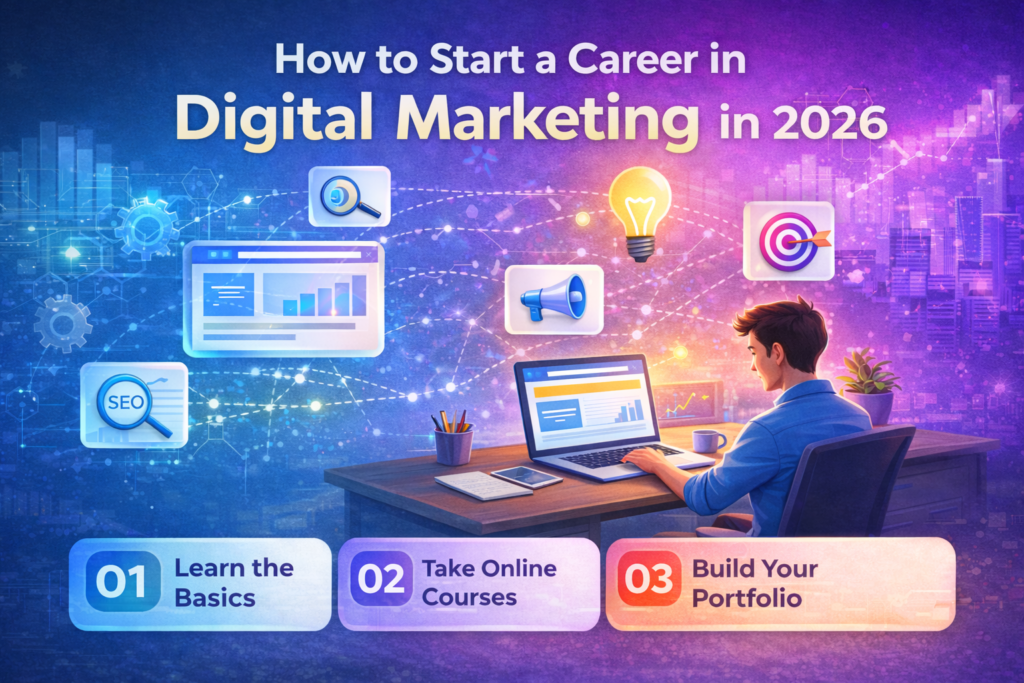
    How to start a career in digital marketing in 2026 step-by-step guide infographic

    If you are wondering how to start a career in digital marketing in 2026, you are not alone. Many students today are interested in digital marketing because it offers good career growth, flexible work options, and strong earning potential. When I first started learning digital marketing, I was confused about where to begin. In this blog, I will explain step-by-step how to start a career in digital marketing in 2026 in a simple and practical way.

    How to Start a Career in Digital Marketing in 2026: Step-by-Step Guide

    1. Understand the Basics of Digital Marketing

    Before jumping into advanced tools, you must understand the basics.

    Digital marketing includes:

    • Search Engine Optimization (SEO)

    • Google Ads

    • Social Media Marketing

    • Content Marketing

    • Email Marketing

    • Affiliate Marketing

    Start by learning what each field means and how they work together. You don’t need to master everything at once — just build a strong foundation.


    2. Take Online Courses and Certifications

    The next step in starting a career in digital marketing in 2026 is learning from structured courses.

    You can:

    • Watch YouTube tutorials

    • Take Google Digital Garage courses

    • Learn from certified digital marketing institutes

    • Practice through online platforms

    Certifications help build your credibility, especially when you are applying for internships or jobs.


    3. Learn Practical Skills (Very Important)

    Theory is not enough.

    To start a career in digital marketing in 2026, you must practice.

    You can:

    • Create your own blog website

    • Start an Instagram page

    • Run small ad campaigns

    • Practice keyword research

    • Optimize your own website

    Practical experience helps you understand real-world problems and solutions.

    If you want to understand the difference between organic traffic and paid traffic, you can read our detailed guide on SEO vs Google Ads: Which is Better for Beginners? to build a strong foundation.


    4. Build Your Portfolio

    Before applying for jobs, build a small portfolio.

    Your portfolio can include:

    • SEO projects

    • Website traffic reports

    • Social media growth screenshots

    • Sample ad campaigns

    • Blog articles

    Even small projects show your skills.

    When I started, I realized companies care more about skills than degrees.


    5. Apply for Internships or Freelance Work

    After learning basics and building a portfolio, apply for:

    • Digital marketing internships

    • Freelance projects

    • Part-time remote work

    In 2026, many companies prefer skilled candidates over experienced ones. If you can show results, you can grow quickly.


    6. Stay Updated With Trends

    Digital marketing changes very fast.

    To grow in your career:

    • Follow marketing blogs

    • Learn AI tools

    • Stay updated with Google updates

    • Improve your skills regularly

    Consistency is the key.

    You should also explore how artificial intelligence is shaping the industry by reading our blog on How AI is Changing Digital Marketing in 2026.


    Career Opportunities in Digital Marketing

    If you start a career in digital marketing in 2026, you can become:

    • SEO Executive

    • Social Media Manager

    • Google Ads Specialist

    • Content Strategist

    • Performance Marketer

    • Digital Marketing Manager

    The demand for digital marketers is increasing every year.

    If you are interested in local business marketing, check out our complete guide on How Local Businesses Can Use Google Business Profile for Growth.


    Conclusion

    Starting a career in digital marketing in 2026 is one of the smartest decisions for students today. You don’t need a technical background — you just need the right guidance, consistent practice, and real projects.

    Focus on learning, practicing, and building your portfolio step by step. With the right skills and dedication, you can build a successful digital marketing career.

    If you want to learn practical digital marketing skills and work on real projects, you can connect with Vidya Sarthi Institute of Digital Marketing to explore learning opportunities and industry experience.


    Frequently Asked Questions (FAQs)

    1. Is digital marketing a good career in 2026?

    Yes, digital marketing is one of the fastest-growing career fields in 2026. Businesses of all sizes need online marketing experts to grow their presence, generate leads, and increase sales.


    2. What qualifications are required to start a career in digital marketing?

    You do not need a specific degree to start a career in digital marketing. Practical skills, certifications, and hands-on experience matter more than formal education.


    3. How long does it take to learn digital marketing?

    It usually takes 3 to 6 months to learn the basics of digital marketing. However, mastering advanced skills requires continuous learning and practical experience.

    4. Can beginners start digital marketing without experience?

    Yes, beginners can start digital marketing by creating personal projects like blogs, social media pages, or small ad campaigns to build experience and a portfolio.


    5. What is the average salary of a digital marketer in India?

    In India, entry-level digital marketers can earn between ₹15,000 to ₹30,000 per month, depending on skills and location. Experienced professionals can earn much higher salaries.

  • SEO vs Google Ads: Which is Better for Beginners?

    SEO vs Google Ads: Which is Better for Beginners?

    Written by: SHUBHAM Date: 01/03/2026
    SEO vs Google Ads infographic comparing organic SEO results and paid Google Ads for beginners.

    If you are new to digital marketing, one common question you might have is: SEO vs Google Ads — which is better for beginners? When I started learning digital marketing, I was also confused between these two. Both help businesses get traffic from Google, but they work in very different ways. In this blog, I will explain the difference between SEO and Google Ads in simple words so you can decide which one is better to start with.

    What is SEO?

    SEO (Search Engine Optimization) is the process of improving a website so that it ranks higher on Google organically (without paying for ads).

    For example, if someone searches for “best digital marketing course near me,” and your website appears on the first page without running ads — that is SEO.

    SEO includes:

    • Keyword research

    • On-page optimization

    • Content writing

    • Backlink building

    • Technical improvements

    The best part about SEO is that once your website ranks, you can get free traffic for a long time. But SEO takes time — sometimes 3 to 6 months to see strong results.


    What is Google Ads?

    Google Ads is a paid advertising platform where you pay Google to show your website at the top of search results.

    When you search something on Google and see “Sponsored” results at the top — those are Google Ads.

    With Google Ads, you can:

    • Appear on the first page instantly

    • Target specific keywords

    • Control your budget

    • Track conversions

    The biggest advantage is speed. You can start getting traffic the same day. But the moment you stop paying, the traffic also stops.


    SEO vs Google Ads: Key Differences

    Here is a simple comparison:

    Cost
    SEO is free but requires time and effort.
    Google Ads requires money but gives quick results.

    Speed
    SEO is slow and long-term.
    Google Ads is fast and immediate.

    Trust
    Users often trust organic results more.
    Some users skip ads and click organic results.

    Long-Term Value
    SEO builds long-term authority.
    Google Ads works only while you pay.


    SEO vs Google Ads: Which is Better for Beginners?

    Now comes the main question — SEO vs Google Ads, which is better for beginners?

    In my opinion, if you are a student or beginner, start with SEO first.

    Why?

    • You learn website optimization

    • You understand keywords

    • You improve content writing skills

    • You don’t need a big budget

    Once you understand SEO basics, then you can move to Google Ads and learn paid campaigns.

    However, if a business wants fast results and has a budget, Google Ads is a great option.


    Can You Use Both Together?

    Yes, and that is actually the best strategy.

    Many successful businesses use:

    • SEO for long-term growth

    • Google Ads for quick traffic and sales

    Using both creates a strong digital marketing strategy.


    Conclusion

    SEO vs Google Ads is not about which one is better overall — it depends on your goals. For beginners, SEO is a great starting point because it helps build strong fundamentals without spending money. Google Ads is powerful for fast results but requires budget and proper strategy.

    If you are learning digital marketing, understanding both SEO and Google Ads will give you an advantage in the industry.

    If you want to learn practical digital marketing skills with real projects and understand how SEO and Google Ads work together, you can connect with Vidya Sarthi Institute of Digital Marketing to explore more learning opportunities.

    You can also read our detailed guide on Google Business Profile for local businesses.

  • How Local Businesses Can Use Google Business Profile for Growth

    How Local Businesses Can Use Google Business Profile for Growth

    Written by: SHUBHAM   on: 25/02/2026             

    How Local Businesses Can Use Google My Business for Growth

    Introduction

    Today, most people search on Google before visiting any shop, restaurant, or service provider. Whether someone is looking for a salon, grocery store, or digital marketing agency, they first check Google. If your business does not appear there, you may lose potential customers.

    In this blog, I will explain how local businesses can use Google Business Profile to increase visibility, build trust, and grow faster.

    1. What is Google Business Profile?

    Google Business Profile is a free tool provided by Google that allows local businesses to appear in Google Search and Google Maps.

    When someone searches for “digital marketing agency near me” or “best bakery in Faridabad,” Google shows local business listings with ratings, reviews, photos, and contact details. This is where Google Business Profile plays an important role in attracting customers.

    2. Increase Local Visibility

    One of the biggest advantages of Google Business Profile is improved local visibility. When your profile is properly optimized, your business can appear in the local results section on Google.

    This helps people in your area discover your business easily. For small and medium businesses, this is very powerful because it brings customers without spending money on paid advertisements.

    3. Build Trust with Reviews

    Customer reviews strongly influence buying decisions. When people see positive reviews and high ratings, they feel more confident about choosing that business.

    Local businesses should encourage happy customers to leave reviews. Responding to reviews, whether positive or negative, also shows professionalism and improves brand reputation.

    4. Share Updates and Offers

    Google Business Profile allows businesses to post updates, offers, events, and announcements directly on their listing.

    For example, if a shop launches a new product or offers a festival discount, they can share it through their profile. This keeps customers informed and increases engagement.

    5. Add Photos and Business Information

    Adding real photos of your store, team, or services makes your profile more attractive. Businesses with updated photos often receive more clicks and calls.

    It is also important to maintain accurate information such as business address, phone number, working hours, and website link. Updated information ensures customers can contact or visit you without confusion.

    6. Track Performance with Insights

    Google Business Profile provides performance insights that show how customers find your business, how many people call you, request directions, or visit your website.

    These insights help business owners understand customer behavior and improve their local marketing strategy.

    Conclusion

    Google Business Profile is a powerful and free tool that every local business should use. It increases visibility, builds trust through reviews, allows businesses to share updates, and provides useful performance insights.

    In my opinion, even small businesses in cities like Faridabad can grow faster if they properly optimize their Google Business Profile. It is one of the simplest and most effective ways to attract local customers.

    If you found this blog helpful, feel free to share it with your classmates or leave a comment with your thoughts.

    If you are a local business owner and want to improve your online presence, you can connect with Vidya Sarthi Digital Marketing to learn how to optimize your Google Business Profile and grow your local business effectively.

  • How AI is Changing Digita Marketing in 2026

    AI in Digital Marketing 2026: How AI is Transforming the Future

     Written by: SHUBHAM     25/02/2026
    How AI is Changing Digital Marketing in 2026​

    AI in Digital Marketing 2026 is changing the way businesses promote their products and services online. Digital marketing is evolving very fast, and Artificial Intelligence (AI) is one of the biggest reasons behind this transformation. Earlier, marketing was mostly manual and time-consuming, but now AI tools are making everything faster, smarter, and more efficient. In this blog, I will share how AI in digital marketing 2026 is transforming the industry and why it is important for students and marketers to learn it.

    1. AI in Digital Marketing 2026 is Making Content Creation Faster

    When I joined my digital marketing class, I realized how much content matters — blogs, captions, emails, ads, everything needs content.

    Now in 2026, AI tools like ChatGPT help marketers:

    • Generate blog ideas

    • Write social media captions

    • Create ad copy

    • Draft emails

    Earlier, writing a blog could take hours. Now AI gives a rough draft in minutes. This saves time and increases productivity.

    2. AI in Digital Marketing 2026 is Transforming Online Advertising

    AI has completely changed online advertising. Platforms like Google Ads and Facebook Ads use AI algorithms to:

    • Target the right audience

    • Analyze user behavior

    • Optimize ads automatically

    • Reduce wasted budget

    For example, if someone searches for “best digital marketing course near me,” AI helps show relevant ads to that person. This improves conversion rates and saves money.

    3. AI in Digital Marketing 2026 is Improving SEO Strategies

    SEO (Search Engine Optimization) is very important in digital marketing. In 2026, AI tools help in:

    • Keyword research

    • Competitor analysis

    • Content optimization

    • Website performance tracking

    AI tools suggest which keywords to target and what type of content will rank better on Google. This makes SEO easier for beginners.

    4. Personalized Marketing

    Today customers expect personalized experiences. AI helps businesses:

    • Send personalized emails

    • Recommend products

    • Show customized website content

    For example, when we shop on Amazon, it shows products based on our previous searches. That is AI working in the background.

    Personalization increases trust and customer satisfaction.

    5. Will AI Replace Digital Marketers?

    Many people think AI will replace digital marketers. In my opinion, AI will not replace humans completely.

    AI can help with data, automation, and speed, but:

    • Creativity

    • Emotional understanding

    • Strategy building

    These things still require human intelligence. AI is a tool, not a replacement.

    Conclusion

    AI in Digital Marketing 2026 is changing digital marketing by making it faster, smarter, and more personalized.

    As a digital marketing student, I believe learning AI tools is very important for future growth. Instead of fearing AI, we should learn how to use it effectively.

    If you found this blog helpful, you can share it with your classmates or leave a comment with your thoughts about AI in digital marketing.

    If you want to learn practical digital marketing skills and understand how AI tools are used in real projects, you can also connect with Vidya Sarthi Digital Marketing to explore more learning opportunities and industry experience.